Newsletter: June 2026
This piece of writing is going to be built around a story which you may be familiar with. I recently blogged it and what follows will make more sense if you are able to read it first, so here’s the link:
Here we have the life of Mahud, a life of openness to events. It’s a compressed life; there’s a lot we don’t know about Mahud. But we have an outline of his story, mainly through the series of odd jobs that he does; and I don’t write that in a dismissive way. All jobs are odd jobs.
And it’s encouraged me to do something similar with my life, as I don’t often pause to look back. So if you don’t mind being a kind listening ear, here’s my life through the lens of my own odd jobs.
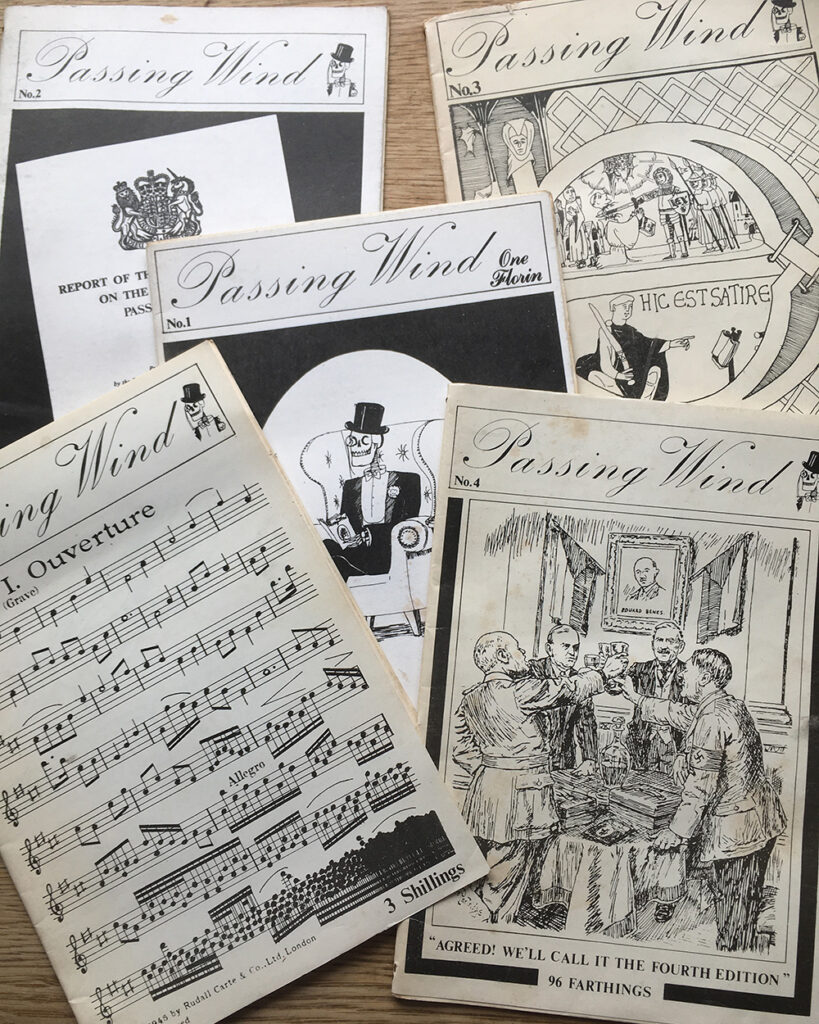
My first odd job was in the world of satire. At uni, I had a friend called Nick Newman who went on to become a wonderful cartoonist for the Sunday Times. Together we started a satirical magazine called Passing Wind, which was successful in its own way and which we passed on to a friend, who went straight from editing that to editing Private Eye. His name was Ian Hislop, who is still a public figure you may love or hate.
Meanwhile, I was writing scripts for radio and TV and taking shows to the Edinburgh Fringe. I remember at uni going to an audition set up by a student called Richard Curtis. He was doing a two-hander show, and he seemed to like my stuff, but I was pipped to the post by some guy called Rowan Atkinson. I don’t know what happened to him, but I hope he’s happy. (Richard went on to direct Four Weddings and a Funeral and Notting Hill, and to create the magnificent Blackadder, The Vicar of Dibley and Comic Relief. He clearly didn’t miss me.)
And then came Spitting Image. I remember on election night, there was going to be a live show and I had four scripts in the running order, which was good and I was excited. But in the end, the show over-ran, as live shows and sermons often do, and all my scripts were cut because I couldn’t be there in the studio to fight my corner due to a work commitment.
And my work commitment was a parish meeting, because alongside the satire story was a church story. A spiritual experience I had at uni changed the direction of my life, and by the time my four scripts were dropped by Spitting Image, I was a vicar in London’s West End, my next odd job.
And after that, I dropped scriptwriting, and for the next 20 years I was happily and despairingly a priest in London.
Communities are uniquely creative and uniquely destructive, and looking after a community is not a holiday. But I remember the annual pantomimes, which were open to anyone in the community. Everyone was promised a part of some sort, which sometimes meant a cast of 80. Challenging, but a wonderfully different way to relate with each other.
And I remember the 17-hour vigils from Maundy Thursday evening through to 3pm on Good Friday, another way to relate. The church became a camp site, constant coffee on the go, teenagers in sleeping bags, a gospel reading on the hour and something else – music, poetry, story – on the half hour. Oh, the stillness at 4 in the morning! We’re in Gethsemane, and the only noise is the kettle on the boil, making another cup of tea. It was the only event in the year one parishioner came to. ‘It’s the only time the church is sad enough,’ she said.
Sometimes after an evening meeting, I’d walk my curate back to her flat. I remember saying to her, ‘One day, you’ll be a bishop and I’ll be your chaplain.’ And Rachel went on to become a wonderful Bishop of Gloucester and a powerful speaker in the House of Lords. And wise enough not to ask me to be her chaplain.
I remember also marrying Ian Hislop (let the reader understand) with his wife Victoria going on to become a successful novelist. I also preached a couple of times at St Paul’s Cathedral. It was a huge honour to stand in that pulpit; such a sense of place and history. I love the history of London, which is why I wrote this, a story which features St Paul’s:
It is also the largest pulpit I have ever come across, with the dimensions of a decent-sized bedroom. When you get to the top of the pulpit steps, don’t be fooled, you’re not there yet. There’s still some way to go to the lectern.
But then the Angel Khabir turned up and that adventure came to an end. After 20 years as a priest I felt the adventure was over and it was a ‘jump in the river’ moment for me. I didn’t have anything to go to; I just knew I had to leave.
And at the same time my priesthood ended, my marriage ended. So two things I thought would be for always turned out not to be so. I can feel the trauma now. As the child learns when their balloon pops on a sharp stick, or they drop their ice cream on the pavement – nothing is stable, all is unstable; everything impermanent. This is true.
But nothing is the end of the story; this is also true. Life goes on and I was pulled out of the river by a supermarket offering me a job in the fruit and veg section, though I’d be on the tills at lunch. And I worked there fairly happily for three years, my time there recorded in my book Shelf Life:
I was appointed union rep. on the same day the Pope was elected. But while his ceremony (I think it was a man) took place amid the exotic Vatican glory of red velvet and gold, my appointment was made in the cold store surrounded by chilled chicken legs – it was the only room available. Fortunately, it was a short meeting.
People sometimes ask if it felt different being a supermarket worker rather than a priest. It genuinely felt no different. I was the same person, after all. ‘It’s not what we do but who we are’ and all that stuff. But it was nice to be free of the dog collar and all the projections that manifests, making you either better or worse than you are. People’s God-projections, authority hang-ups or rage at the church are not a helpful conduit for human encounter. It was good to be able to talk to people with less baggage present.
And then the Angel Khabir turned up again and I left the supermarket. To cut a long story short, I had written a book called The Beautiful Life, published by Bloomsbury – and now available as The Journey Home:
This book led me to jump in the river again and risk self-employment, which exposed my survival fears. I was doing some retreats and people began coming to see me for counsel. And suddenly (and slowly) the therapy journey was born; a journey neither planned nor imagined. It simply appeared.
But here I was, employed by people I never imagined would employ me. Southampton City Council asked me to look after their social workers; while for the last 12 years I’ve had a contract with the NHS to look after doctors, nurses and consultants. I’ve also sometimes met with medical staff who have reached the end of their coping, who are contemplating suicide. I’ve also worked in schools for a similar length of time, seeing staff who need to talk.
Most of this odd job is with private clients, but a Dutch bank did send me to Amsterdam, Madrid and the Swiss Alps to work with their staff (not all on the same day). And if you’re wondering how this all happened, so am I.
If you’d asked the aspiring satirist, happily dismantling power, if he would he ever be a vicar, he’d have said, ‘Yeah, right.’ If you’d asked the vicar if he’d ever be a union rep in a supermarket, he’d have probably have smiled graciously and said, ‘Unlikely.’ And if you’d asked a supermarket worker stacking coleslaw if he’d ever be counselling bankers in the Swiss Alps, he’d have said, ‘I just can’t see how that would happen.’
When I look back on things, like Mahud, I’m aware I’ve not been in control of the process. And I tell my stumbling story now only to highlight its fragility and impermanence. There is no plan, just an unfolding. Some doors have opened, many have not. I’ve had many rejections since Richard opted for Rowan; and I’ve not always equalled Mahud’s spirit of acceptance. But perhaps, learning from him, one of my present-day mantras is ‘I’m not in control and that’s OK.’ I can hold it all more kindly now.
And obviously the true magnificence here is found neither in Mahud’s tale, nor mine, but in your story – your unique story, which you have lived as best you can. You’ve probably met the Angel Khabir on occasion, whether happily or unhappily. And I’m sure you’ve had to jump in the river a few times.
So this piece of writing is in celebration of your fragile, impermanent and glorious journey, which I hope you can sometimes hold kindly.
And with best wishes now, however the day goes, from a fellow traveller.
Simon x
P.S. I’m doing a day retreat at the House of Prayer on 25th July. It’s called ‘Staying sane in insane times.’ Details here:
